
Constitution / Part I
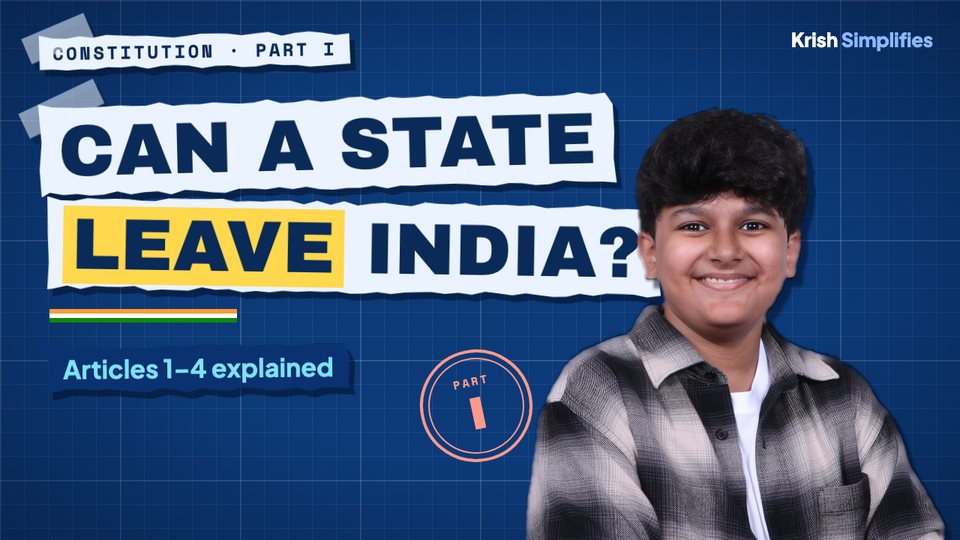
Part I · Articles 1 to 4Can a Stateleave India?
The Union and its Territory: what India is, how new States come in, and how Parliament can redraw the map.
 37 min · goes live at launch
Narration in an AI model of Krish's own voice, used with permission. Intro by Krish.
Inside the video
- Hi, I'm Krish
- Page one, sentence one
- Article 1: Name and territory of the Union
- Two names, one country
- Why “Union”, not “Federation”
- What counts as India
- Article 1: real examples
- Article 2: Admission of new States
- The Sikkim story
- Article 2 vs Article 3
- The Berubari case
- Article 3: New States, borders and names
- Five powers of Parliament
- Consult, not consent
- Telangana, 2014
- Article 4: The Schedules
- The simple-majority rule
- How the four Articles fit together
- Key callouts for revision
- Recap
- What's next
Part I in one minute
The four Articles
Name and territory of the Union
India is a Union of States. The names and areas of the States and Union Territories are listed in the First Schedule.
Admitting or establishing new States
Parliament can do this by an ordinary law. It brings land in and never gives land away.
Changing existing States
Parliament can form a new State, increase or diminish its area, or alter its boundaries or name. The State is consulted, but it cannot stop the law.
The helper Article
A law under Article 2 or 3 also updates the Schedules. It is not an amendment under Article 368, so a simple majority is enough.
Exam traps
- The affected State is consulted, but its consent is not needed.
- Giving land to another country needs a constitutional amendment (Berubari, 1960, then the 9th Amendment).
- Sikkim joined by the 36th Amendment (1975), not an ordinary Article 2 law.
- Article 2 is new land coming in. Article 3 is existing States being changed.
Short clips from this episode
- What's on page one of the Constitution
- India or Bharat
- Can a State leave India
- What counts as India
- How Sikkim became a State
- Can India give away its land
- Can Parliament redraw India's map
- A new State by simple majority
Spotted a mistake? Write to krishsimplifies.official@gmail.com and we will check it against the source and correct it.